


Our customer democracy model until 14 April 2027
At the Annual General Meeting held on 16 April 2026, it was resolved that the Assembly of Delegates will be replaced by a Board of Representatives.
The Assembly of Delegates will remain in place until the Annual General Meeting to be held in 2027 – even though the first election to the Board of Representatives will take place this autumn.
The Assembly of Delegates will be dissolved on 14 April 2027, after which the Board of Representatives will take office.
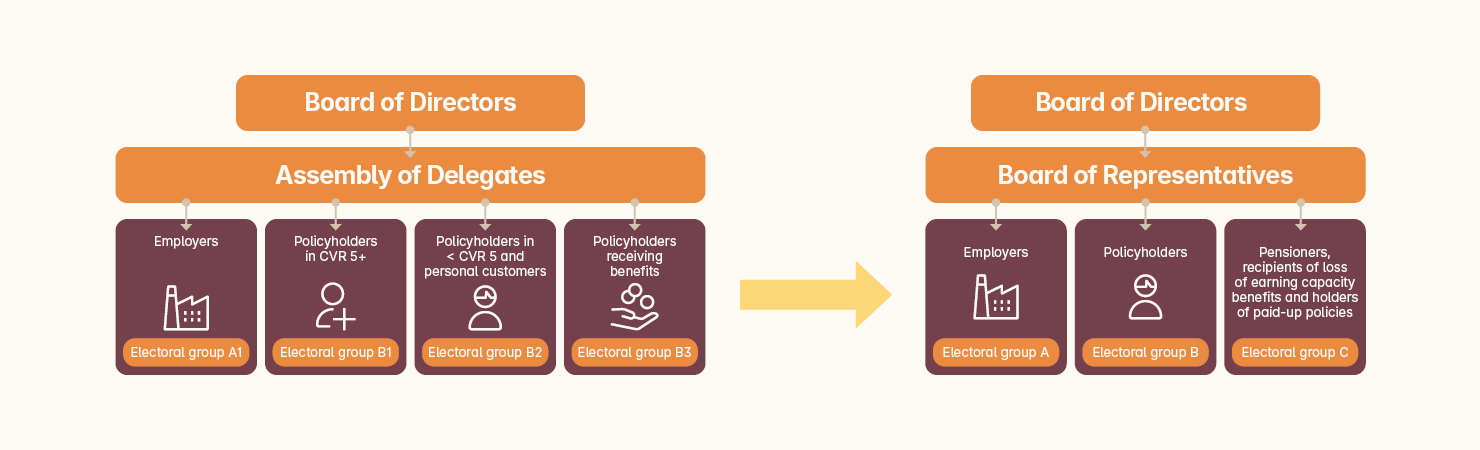
What is the new model about?
The Board of Representatives will consist of around 100 representatives instead of the approximately 700 delegates. The election will be organised into three electoral groups instead of four, and the Board of Directors will be the same for both the Association and the Life Insurance Company. This provides a more transparent, more robust and more effective decision-making structure.
More effective and ongoing influence
Representatives will have the opportunity to engage in ongoing dialogue and discussion – not just once a year. They will also be better equipped to understand complex issues, which pensions can sometimes be.
Broad and fair representation
All customer groups will continue to be represented. Pensioners may even have a greater say, as they, together with customers holding paid-up policies, may elect up to 20 representatives. Major companies may nominate two representatives because they represent a significant proportion of customers in terms of the number of policyholders and the amount of their savings.
A modern and professional customer democracy
The model is consistent with the structure of other large customer-owned and association-owned companies. It promotes continuity, skills development and long-term ownership.
What happens next?
The resolution to establish the Board of Representatives was made at the 2026 Annual General Meeting, and the first election to the Board of Representatives will take place in autumn 2026 – further details regarding the election will be published on AP Pension’s website and sent by letter to our customers. The current delegates will remain in office until the day before the 2027 Annual General Meeting.
Election regulations for the Board of Representatives
Learn more about the Board of Representatives
Q&A – A new customer democracy model
Why will the Board of Representatives comprise up to 100 members?
The Board of Representatives replaces the former Assembly of Delegates and has been deliberately downsized in order to create a better framework for dialogue, engagement and effective ownership. Experience shows that a smaller forum allows for closer cooperation and a deeper exploration of complex topics. The size has been determined on the basis of AP Pension’s experience and that of customer-owned peers.
Why are representatives elected for a three-year term?
A three-year term of office gives representatives a better opportunity to gain a thorough understanding of the work and make qualified contributions over time. At the same time, it ensures continuity within the Board of Representatives and simplifies the electoral system, as elections are held in only one electoral group at a time.
How does the election for the three electoral groups take place?
All candidates submit their candidacy via the same digital portal during the registration period. In the election, employers vote in electoral group A, insured customers in electoral group B and customers receiving benefits or holding a paid-up policy in electoral group C. The candidates who receive the most votes in each electoral group are elected as representatives.
What does the new model mean for the election to the Board of Directors?
It is the members of the Board of Representatives who are eligible to stand for election to the Board of Directors. This ensures that board members have an understanding of AP Pension, experience of customer democracy and a clear mandate from customers. All electoral groups will continue to be represented on the Board of Directors, provided they put forward candidates.
How is the Board of Representatives simpler than the previous model?
The new model involves fewer electoral groups, a fixed three-year electoral cycle and a significantly lower number of elected representatives. At the same time, there is a single joint Board of Directors for the Association and the Life Insurance Company. Taken together, this provides a more transparent and more robust decision-making structure.
How are the three groups composed?
The Board of Representatives consists of three electoral groups:
Electoral group A: Employers – up to 40 representatives. Major companies may nominate two representatives.
Electoral group B: Insured customers – up to 40 representatives.
Electoral group C: Customers receiving benefits or holding a paid-up policy – up to 20 representatives.
Each representative has one vote.
Why is there a difference in the number of representatives in the electoral groups?
The allocation reflects both the composition of the customer base and the different roles represented by the electoral groups. For example, employers play a key role in choosing a pension scheme, while customers receiving pension benefits may, overall, have stronger representation than under the previous model.
What are the formal responsibilities of the representatives?
The Board of Representatives is responsible for:
Approving the annual report and the consolidated financial statements
Making resolutions to amend the articles of association
Electing the Association’s Board of Directors
Do the representatives receive a fee?
Yes. The representatives receive an annual fee as well as reimbursement of travel expenses incurred in connection with meetings of the Board of Representatives in accordance with the applicable rates.
Does the new model take away customers’ influence?
No. Customer influence is retained, but organised differently. All customers may continue to attend general meetings, while voting rights are held by representatives elected directly by the customers.
Will democracy become more closed or less inclusive?
The new model is designed to make it easier to engage. A simpler setup, direct elections and a reasonable fee encourage broad participation across all types of customers and backgrounds.
What does the new model mean for ordinary customers and pensioners?
All customers may continue to engage in customer democracy and stand as candidates. Under the new model, pensioners and customers receiving benefits will have greater and more focused representation than before.
When will the new model take effect?
The first election to the Board of Representatives will take place in autumn 2026. The current delegates will remain in office until the day before the 2027 Annual General Meeting, at which the newly elected representatives will formally take office.
How have customers and delegates been involved in the process?
In considering the model, the Board of Directors was assisted by the Election, Remuneration and Competence Committee. The proposal has been presented to and discussed with delegates on an ongoing basis in the run-up to the Annual General Meeting, including at delegates’ meetings and via webinars.
Will it be possible to propose changes to the model in future?
Yes. As is currently the case, proposals for amendments to the articles of association may be submitted prior to forthcoming general meetings.
What are the eligibility rules if your circumstances change?
The new election regulations set out the rules on eligibility. As before, representatives must meet the fit and proper requirements and may not continue in their role if, for example, they are no longer a customer or take up employment with a competitor.